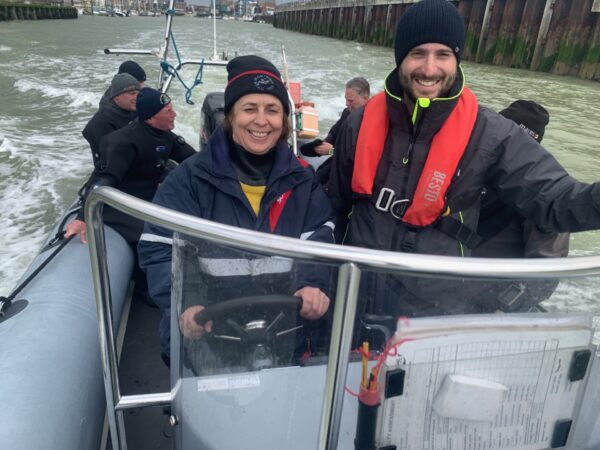
Worthing BSAC aims to organise a UK diving trip every year, usually to familiar favourites such as Portland or Plymouth, and every other year we try to venture a little further afield in search of warmer waters and, hopefully, better visibility!
Our previous overseas adventure had taken us to the Red Sea in Egypt on a liveaboard, but this time we decided to explore Malta, an island renowned for its wrecks, caves, reefs and some of the clearest water in the Mediterranean.
Eight of us signed up for the adventure: Russ F, Martin, Gabbi, Lisa, Rob, Peter, Guy and Brendan and two brave non diving partners joined us. We were a mixture of relatively new and more experienced divers, with Sports Diver being the minimum qualification required for the trip.
We flew out of Gatwick on the Sunday, arriving in Malta ready for a week of diving, sunshine and the occasional bit of sightseeing.
We had booked our diving and accommodation through Maltaqua, who proved to be an excellent choice. Our apartments were lovely, spacious and comfortable, and conveniently located just around the corner from the dive centre. There was even a dedicated drying room downstairs for all our diving equipment, which was a real bonus when you have eight divers trying to dry wetsuits, boots and assorted kit every evening.
On Monday morning we made the short walk to the Maltaqua shop, where we went through the usual paperwork, qualifications, equipment checks and dive briefings before finally heading off for our first dive.
Our first day’s diving was by boat, heading out towards the small island of Comino, which sits between Malta and Gozo.
Our first dive was at Santa Maria Caves, a relatively shallow site at around 10 metres and an ideal introduction to Maltese diving. With caves, overhangs and swim-throughs to explore, it was a great way to get everyone comfortable in the water and accustomed to the conditions.
The visibility was immediately impressive. For those of us more used to diving in the UK, being able to see where you were going without practically bumping into your buddy was a welcome change!
After any initial dive its time to check if your weights are correct and the tank size. One of our members was running out of air extremely quickly moving from a 12l to a 15l immediately. This then moved up to the ‘unicorn’ of tanks – the 18l and a recommendation that he start to ‘kiss the budgie’!!! This turned out to be a way of breathing as if you were kissing a bird ie shallow and not taking big breaths in and out. This of course turned out to be the joke of the trip!
Our second dive was on the P31 patrol boat, a former military vessel deliberately scuttled to create an artificial reef and diving attraction.
Sitting at around 20–23 metres, the P31 is an impressive wreck, with large openings cut into the structure to allow suitably qualified divers to explore parts of the interior. The wheelhouse was particularly interesting, and the excellent visibility meant you could really appreciate the scale and layout of the vessel.
It was a fantastic start to the trip and gave us a taste of what Malta had to offer.
For the remaining diving days, we swapped the boat for shore diving. Malta is particularly well known for its accessible shore dive sites, although accessible doesn’t necessarily mean easy when you’re carrying a full set of scuba equipment over rocks, steps and uneven ground!
One of our dives was on the MV Rozi, a former tugboat deliberately sunk as a diving attraction near Ċirkewwa, where the ferries depart for Gozo.
This area is something of a Maltese equivalent of Stoney Cove, with divers everywhere. It is a very popular diving location, and you certainly won’t find yourself short of company underwater.
The Rozi itself is a fascinating wreck, sitting upright on the seabed and offering plenty to explore. With the clear water, it makes for an impressive sight as you approach.
We also explored Caesar’s Pool, in the same general area, which offered a very different sort of dive. This was more about the underwater landscape, with rocky gullies and swim-throughs to negotiate. We even came across some concrete amphorae sitting on the seabed, which looked suspiciously like props from a film set!
Another dive took us to a second patrol boat wreck the P29. This involved a longer surface swim from the entry point, making it a little more demanding, but the wreck was worth the effort. One of its more unusual features was a decorative gun mounted on the bow, giving it a rather dramatic appearance. This became the highlight of the trip for Pete who posed with the gun and Rob got a brilliant photo of him which we believe he’s going to frame and put up on his wall.
Another memorable dive was at Anchor Bay, famous for being the location of Popeye Village, the film set built for the 1980 musical starring Robin Williams, which is now a tourist attraction. A very surreal experience hearing the music of the band and actors in the background as they put on their daily show for the tourists.
Below the surface, Anchor Bay offers an interesting cavern dive with some impressive rock formations.
Unfortunately, we weren’t the only divers who had decided to visit, and the amount of traffic through the cavern had stirred up the sediment, reducing the visibility considerably.
It was a reminder that even in Malta, where the visibility is generally excellent, a few divers in the wrong place can quickly change the conditions!
Nevertheless, it was an enjoyable dive and another very different underwater environment to experience.
One of the highlights of the trip was our visit to Gozo, Malta’s smaller neighbouring island.
Our first dive was at the Inland Sea, one of the best-known dive sites in the Maltese islands.
The dive begins in a sheltered inland lagoon before passing through a spectacular natural tunnel that leads out into the open Mediterranean.
Swimming through the tunnel is quite an experience. As you approach the exit, the blue light of the open sea gradually appears ahead of you, creating a wonderful view.
Once outside, the underwater scenery opens up into dramatic walls and drop-offs, with plenty of interesting rock formations to explore. We also spotted some colourful painted comber fish, which made a welcome change from the usual marine life we had been seeing.
Our other Gozo dive took us to the site of the famous Azure Window, a huge natural limestone arch that had been one of Malta’s most photographed landmarks until it collapsed into the sea during a storm in 2017.
Underwater, the remains of the arch now form an enormous jumble of limestone boulders and rocks. Although the scenery was interesting, the entry and exit were probably the most memorable parts of this dive, and not necessarily for the right reasons!
The terrain was extremely uneven and slippery, making getting in and out of the water with full diving equipment quite challenging. It certainly wasn’t a site for anyone who wasn’t confident on their feet, and we were all relieved to get back onto solid ground safely.
If you’re looking for huge shoals of colourful fish, turtles and sharks, Malta probably isn’t going to compete with the Red Sea.
Throughout the week, we saw plenty of chromis and damselfish, a few banded groupers and even an octopus, but generally the marine life was fairly limited.
What Malta lacks in fish, however, it more than makes up for with its underwater scenery, wrecks, caves and extraordinary visibility.
One creature we certainly didn’t have any trouble finding was the bearded fireworm.
These colourful, bristly creatures seemed to be everywhere, crawling across rocks and the seabed. They may look quite attractive, but they are definitely best admired from a distance. Their bristles can cause a nasty skin reaction, rather like an extremely unpleasant nettle sting, with irritation that can persist for hours.
A good reminder to keep your hands to yourself underwater!
Over four days, we completed eight dives, which might not sound particularly demanding to anyone accustomed to warm-water diving holidays.
However, when you’re used to the UK diving routine of perhaps a couple of dives over a weekend, eight dives in four consecutive days, combined with getting in and out of wetsuits, carrying cylinders, negotiating rocky shore entries and travelling between sites, can be surprisingly tiring.
By the end of the fourth day, I think most of us were ready to give our legs and shoulders a rest!
That said, we had managed to experience a fantastic variety of diving, from shallow caves and dramatic underwater tunnels to patrol boats, tugboats and spectacular rocky reefs.
With the diving finished, our final full day was spent exploring a little more of Malta above the surface.
The group split up, with some heading into Valletta, Malta’s historic capital, and others choosing to visit Mdina, the beautiful fortified city known as the Silent City.
Both offered a chance to enjoy some of Malta’s fascinating history, architecture and atmosphere without having to carry a scuba cylinder around!
It was a lovely way to round off the trip before heading back to the UK.
Absolutely!
Malta offers an enormous variety of diving within a relatively small area. The visibility is generally excellent, the water is warmer than we’re used to in the UK, and the sheer number of wrecks, caves, tunnels and interesting underwater landscapes means there is something for almost everyone.
It is worth remembering, though, that many of the shore dives involve rocky entries, steps and sometimes lengthy walks or swims with equipment, so a reasonable level of fitness and confidence is helpful.
Maltaqua looked after us well, the accommodation was excellent, and having everything organised made the trip straightforward and enjoyable.
Most importantly, it was another great Worthing BSAC club adventure, bringing together divers of different experience levels to explore somewhere new, enjoy some fantastic diving and spend time together away from our usual UK dive sites.
Eight divers, eight dives, four days underwater and plenty of memories. Where shall we go next?
For anyone interested in exploring Malta’s dive sites, the website www.maltadiveguide.com is an excellent resource, with an interactive map showing dive locations, depths, site descriptions and the history of many of the wrecks.